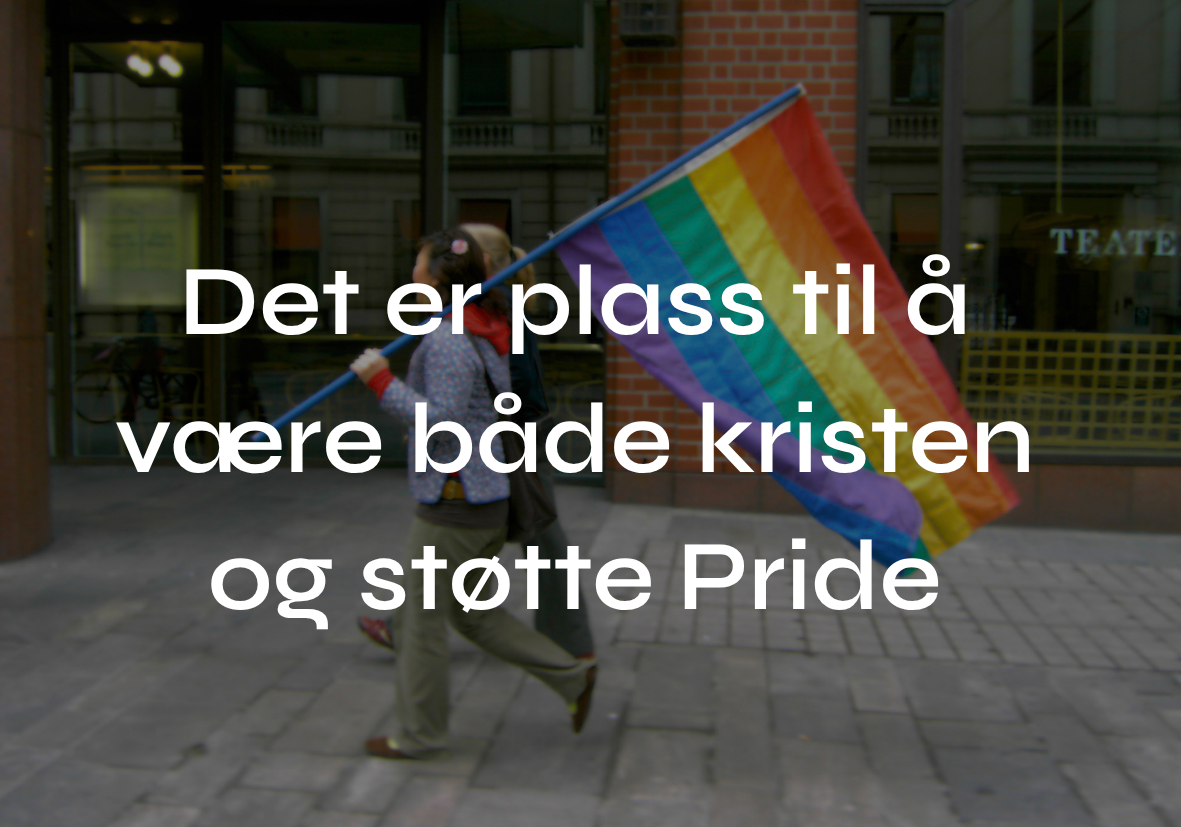
As Christians we should love everyone as they are and stand up against exclusion and discrimination. We believe that the LGBTQ+ community belongs in the church and are loved by God. In this post we showcase the history of LGBTQ+ activism in Norway and Finland, talk about the current issues and call you to take action. This is a collaborative text between SCM Norway (Forbundet) and SCM Finland (SKY), and reflects our shared views.
This year, Forbundet and SKY come together to stand for rights, agency and importance of the LGBTQ+ community. Every human being is worthy of respect and has the right to exist, love and belong without discrimination and hatred.
In 1972, sexual relations between men were decriminalized in Norway. Major societal changes followed this during the late 70s and 80s, but social and cultural stigma remained. Homosexual people continued to face discrimination, hatred and prejudice, especially in religious environments. It would take more than 40 years before same-sex couples could marry in the church. (The Church of Norway, n.d; Rafto, 2023)
Finland decriminalized sexual relations between men one year before Norway, in 1971. Nevertheless, discrimination, shame, and self-censorship continued, while there were also people who challenged prevailing norms.
During the 1970s, several organizations and groups existed for queer Christians in Norway, including Det norske forbundet, which became the predecessor of FRI - The Norwegian Organization for Sexual and Gender Diversity, Åpen kirkegruppe and Norges Kristelige Studentforbund, now known as Forbundet. (FRI – The Norwegian Organization for Sexual and Gender Diversity, n.d.; Den norske kirke, 2016)
In Finland Suomen Kristillinen Ylioppilasliitto (SKY) was founded in 1897, becoming Finland’s oldest Christian student organization. Throughout its history, SKY has been an important arena for students seeking to explore the relationship between faith, society and international engagement. From the 1970s and onward, SKY became involved in issues related to feminism, international solidarity, environmental protection, and the rights of sexual minorities.
Throughout its history Forbundet has been home to several important voices advocating for LGBTQ+ inclusion in the Norwegian churches and its communities. Halvor Moxnes has been a prominent voice in the fight for gay and queer people from the 1970s and until today. (Skeivt Arkiv, 2026) His commitment has helped shift the church debate from questions of condemnation to questions of human dignity, equality, and inclusion.
Two other important voices are Sara Moss and Elisabeth. In 2013 they initiated Kirken på Pride (the church at pride) after attending a similar event in Sweden the year before. Kirken på Pride established a collaboration between Osloforbundet, Åpen kirkegruppe, the Faculty of Theology, Fagforbundet (The Norwegian Confederation of Trade Unions), Presteforeningen (the Norwegian Association of Clergy) and local congregations. Kirken på Pride was intended to function as an arean where young Christians, church institutions and queer communities could meet. This initiative ultimately led to The Church of Norway participating in the Pride parade in Oslo today.
In 2011 SKY was the first Christian organization in Finland to support same-sex marriage through its participation in the broad civil society campaign “Tahdon 2013,” which means “I do”. It ultimately led to the legalization of same-sex marriage in Finland. The organization continues to work for the full acceptance of same-sex marriage within the Finnish Lutheran church as well as supporting the rights of LGTBQ+ people in all churches in Finland.
Although significant progress has been made within both Norwegian society and the church, questions surrounding marriage equality and inclusion continue to create debate today. A current issue in Norway is that although same-sex couples can marry in the church, priests may refuse to officiate such weddings if they do not wish to do so. This creates two different positions within the Christian community in Norway, where both sides will always believe that the other is wrong. Different interpretations of the Bible are often used as the main argument for maintaining two equally recognized theological views of marriage.
The two-view model requires both parties to accept the other and to be willing to stand side by side in the church with people who have a fundamentally different way of reading the Bible. By maintaining two views, confusion is created, and The Church of Norway sends unclear signals to the rest of the institution and its members. Forbundet believes there should be one position and that priests should not be allowed to refuse to marry same-sex couples. We can draw parallels to the ordination of female priests. The first female priest was ordained in 1961, but following many female priests were not accepted by parts of the Christian community. It was not until 2022 that The Church of Norway stated that those seeking ordination to ministry in the church are expected to commit themselves to the church’s doctrinal foundation. This includes recognizing female colleagues as “rightfully called.” The Student Association believes that we cannot wait another 50 years for the same to happen regarding same-sex marriage, and that The Church of Norway can only hold one view. Following this, everyone who wishes to marry will be met with the same respect and inclusion. This is not a question of what is right, nor is it primarily a theological question; it is a question of what is necessary to keep a nationwide church together.
In Finland the issue of same-sex marriage remains controversial, and officially the Evangelical Lutheran Church of Finland does not recognize same-sex marriage. In 2024, the Finnish bishops recommended that priests should be allowed to marry same-sex couples. In 2025, the Church Synod voted on a proposal similar to the Norwegian model: two different theologies of marriage would have co-existed in the church. However, the proposal did not receive the required three-quarters majority. SCM Finland saw the proposal problematic since it would have led to the same kind of problems that the Norwegian movement is now opposing in Norway. The stand of SCM Finland is that the rights of LGBTQ+ people should be recognized everywhere.
Right now, the issue of same-sex marriages remains undefined in the Finnish Lutheran Church. Priests are free to officiate the marriages and the bishops have agreed that there will be no consequences for that. However, not all parishes have opened their doors for same-sex couples and even though any couple can find a priest and a church for marriage, navigating the reality requires prior knowledge and facing rejection. SCM Finland sees the situation as deeply problematic. The issue is not only the right to marriage, but rather how LGBTQ+ people are treated in any church contexts. How are families met when a baptism of a child is on hand? How is a couple coming to mass or family cafe welcomed and treated? As long as there are parishes, clergy and church personnel that do not commit to welcoming LGBTQ+ people, no church spaces will be safe. SKY encourages everyone to challenge the silent acceptance of homophobic and transphobic language in churches and church communities.
SCM Finland is an ecumenical organization and the rights of LGBTQ+ people in any Christian denominations, not just the Lutheran church, in Finland are of importance to us. The reality is that no other churches are anywhere close to discussing same-sex marriages. However, SCM Finland, strongly calls all churches in Finland to start and continue dialogue with their LGTBQ+ members, to recognize the special gifts that God has given to these members of their communities and to, first and foremost, commit to practices that open to church communities to the LGTBQ+ people and strongly condemn homophobic and transphobic language. There is no case where theology excuses hurting our neighbor.
The rights and opportunities LGBTQ+ people have today, did not emerge on their own. They are the result of decades of work by people who challenged exclusion, created communities, and spokespoken up, even when doing so came with significant personal costs. As Christian student movements, we are grateful to those who came before us and helped make our churches and societies more inclusive. We have a responsibility to those who come after us. The choices we make today will shape whether future generations of LGBTQ+ Christians experience the church as a place of belonging, dignity, and love.


Lorem ipsum dolor sit amet, consectetur adipiscing elit. Suspendisse varius enim in eros elementum tristique. Duis cursus, mi quis viverra ornare, eros dolor interdum nulla, ut commodo diam libero vitae erat. Aenean faucibus nibh et justo cursus id rutrum lorem imperdiet. Nunc ut sem vitae risus tristique posuere.
Lorem ipsum dolor sit amet, consectetur adipiscing elit, sed do eiusmod tempor incididunt ut labore et dolore magna aliqua. Ut enim ad minim veniam, quis nostrud exercitation ullamco laboris nisi ut aliquip ex ea commodo consequat. Duis aute irure dolor in reprehenderit in voluptate velit esse cillum dolore eu fugiat nulla pariatur.
Block quote
Ordered list
Unordered list
Bold text
Emphasis
Superscript
Subscript